STEEPLE ENGINE
Anthony Mount


STEEPLE ENGINE
Anthony Mount


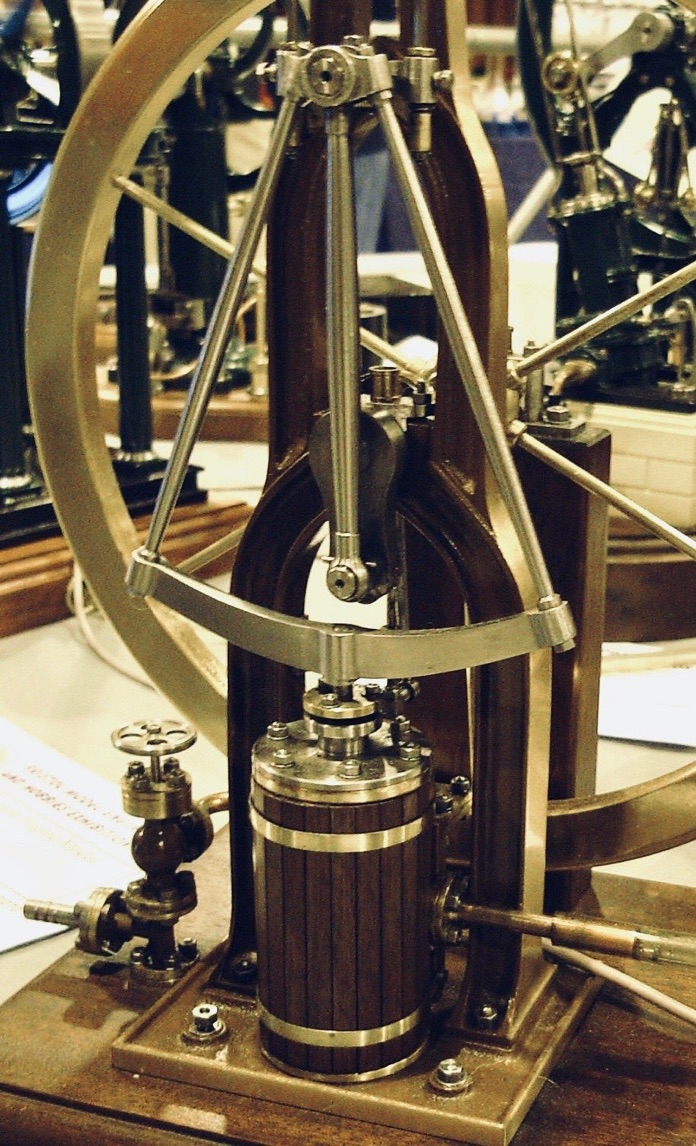
Anthony Mount’s own model, built to his design which has become popular with many model engineers, photographed at a Bristol Exhibition.
The ‘steeple engine’ is so called because of the resemblance of the piston rod extension to a church steeple. They were were an early attempt to move away from the beam engine arrangement.
The first steeple engines were designed by Napier in the 1830s for use in paddle boats. The cylinder went in the bottom of the boat, the crankshaft was at deck level, and the upper section was housed in a deck house.
This model is based on a land engine of the 1860s. The flywheel construction is especially interesting. In full size the boss and rim were cast around wrought iron spokes laid in the foundry mould. This is not possible in a model, so the boss is built up and the rim is a gunmetal casting that can be machined all round. The spokes are rods Loctited in position. The lathe is used as a jig to hold them in position while the Loctite cures.
The model has a 9” (229mm) diameter flywheel. The base, flywheel rim, main frame, cylinder, steam chest and eccentric strap are gunmetal castings. The other parts are machined from mild and stainless steel bar stock.
A full set of drawings are available plus a parts list. The drawings have both imperial and metric dimensions.
The engine is a delight to watch in motion and an interesting project to build. Construction is possible on a 3 ½” (90mm) gap bed lathe. The gap being needed for the flywheel.





Modelengineeringwebsite.com
the only free and the only weekly magazine for model engineers.
Editor: David Carpenter